NagaSilk
- +91 6291439425
- Kohima, Nagaland, India

From our planet to your closet
Unborn Studio is a Bengaluru-based sustainable fashion label founded by NIFT graduate and environmentalist Mounica Chitturi. The brand creates handcrafted clothing using eco-dyeing and eco-printing techniques that rely entirely on leaves, flowers, and other botanical elements as the print medium — no synthetic chemicals, no bleach, and no chemical fixatives anywhere in the process. Unborn Studio sits within Prakati’s sustainable fashion community as one of the country’s more process-driven slow fashion labels, where the dyeing method itself, not just the fabric, is the sustainability story.
Every Unborn Studio garment begins with Kala cotton, a rain-fed, pest-resistant heritage cotton variety native to the Kutch region of Gujarat. Kala cotton is one of the oldest cotton varieties cultivated in India, valued for needing minimal irrigation and no chemical pesticides — a sharp contrast to conventional cotton farming. By building its entire womenswear and menswear range around this fibre, Unborn Studio supports the continuation of a heritage crop that had been steadily losing ground to higher-yield, higher-input hybrid varieties.
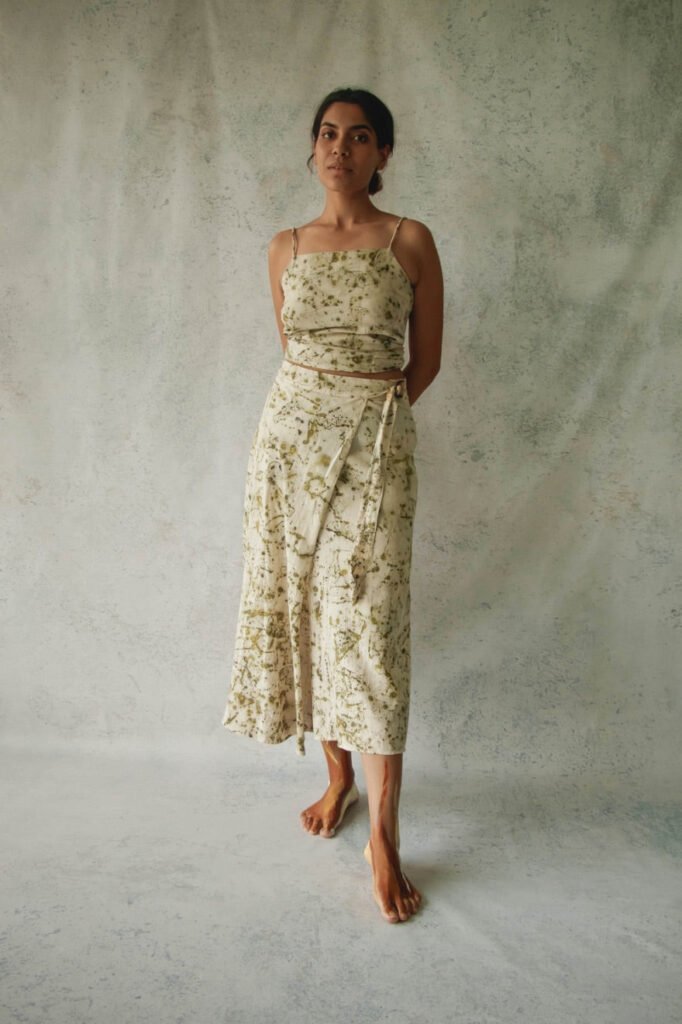
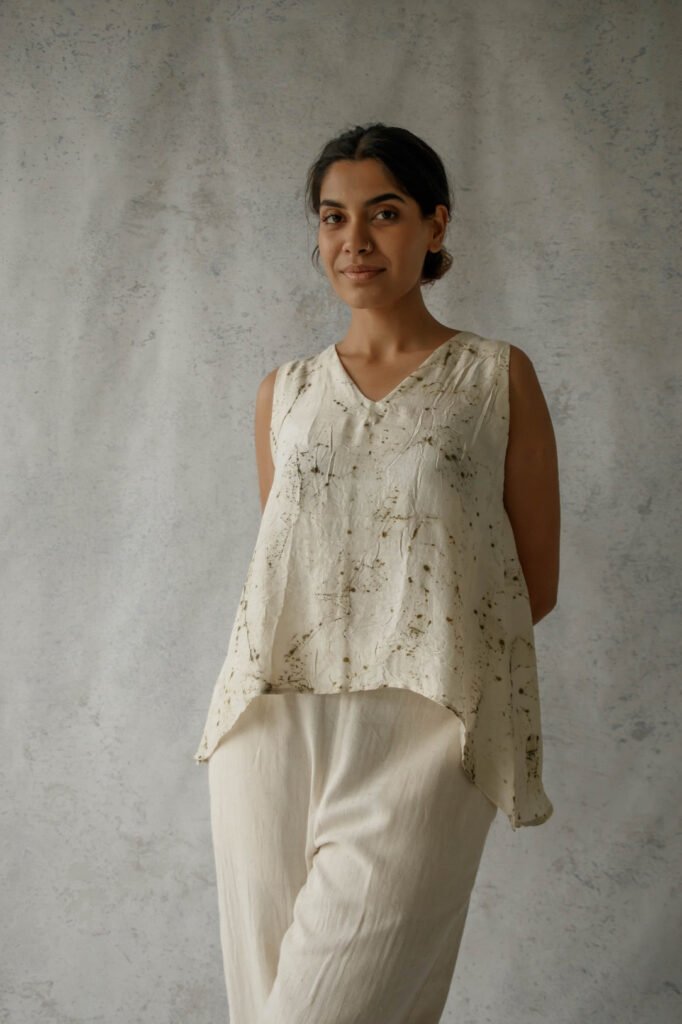
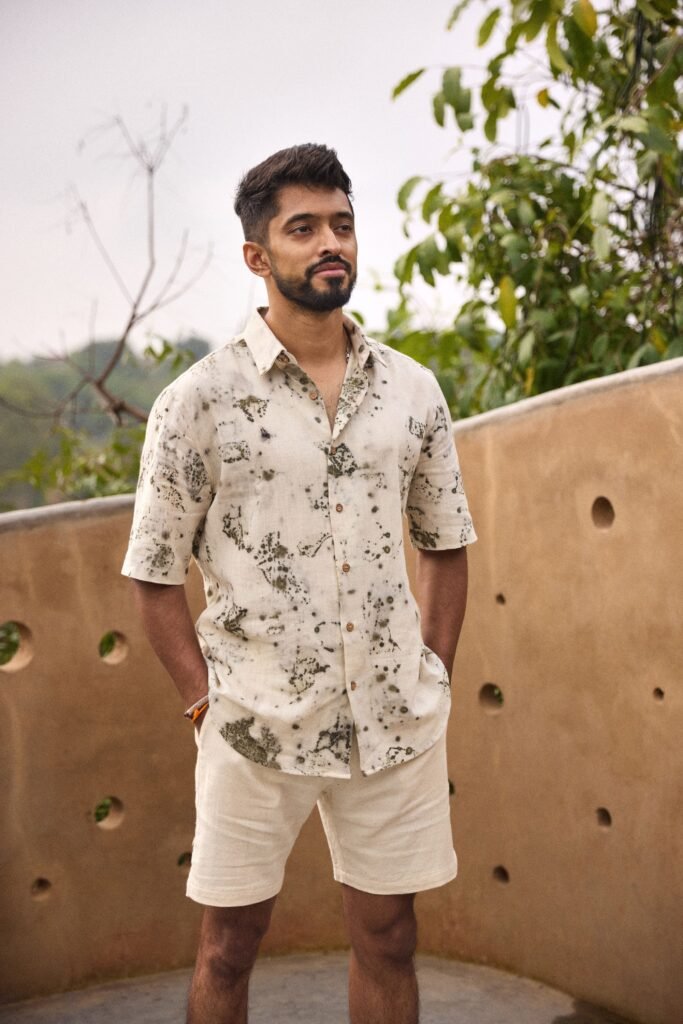
Unborn Studio’s signature technique is eco-printing, sometimes called bundle dyeing. Fallen leaves and flowers, gathered from local gardens surrounding the brand’s dye studio, are bound tightly against the Kala cotton fabric and steamed. The heat and moisture transfer the natural pigments and vein patterns of the botanical material directly onto the cloth. Each bundle then rests for about a week, allowing the dye to fully penetrate the fibres and develop richer, more stable hues.
Where the process departs furthest from conventional textile printing is in what it avoids. Fixing natural dyes onto fabric typically calls for a mordant — a substance that helps the colour bond to the fibre — and many mordants used commercially are synthetic and contain heavy metals. Unborn Studio uses only natural mordants: alum, myrobalan, oak galls, and soy milk. Water used in the steaming process is also reused to irrigate the studio’s own dye garden, which the brand describes as a zero-water-waste approach to natural dyeing.
Because the printed pattern on every piece comes from real leaves and flowers rather than a repeatable screen or digital print, no two garments are ever identical. Each piece carries the unique vein structure, shape, and pigment intensity of the specific leaf or flower pressed against it — the brand’s way of ensuring that “nature doesn’t repeat itself” on the final product.
Unborn Studio’s collections span womenswear — tops, dresses, co-ord sets, skirts, wrap dresses, and slip dresses — along with menswear pieces, handspun cotton and mulberry silk scarves, and even plant-dye kits for customers who want to try the eco-printing technique at home. Products are largely produced in small batches or as one-off pieces, in keeping with the brand’s slow fashion philosophy of deliberate, unhurried production over volume.
Beyond the dyeing technique itself, Unborn Studio’s stated mission is to create rural livelihoods and keep traditional Indian textile crafts alive. Garments are handmade in villages using time-tested methods passed down through generations of artisans, rather than in large-scale mechanised factories. This dual focus — reviving a heritage cotton variety while sustaining the hand-skills needed to work with it — positions the brand as much a craft preservation effort as a clothing label.
For shoppers exploring options from businesses based in Karnataka, Unborn Studio offers a rare combination: a fully botanical dyeing process, a heritage organic cotton fibre, and a production model built around rural artisan employment rather than industrial manufacturing. The brand is a fitting example of what Prakati’s Green Directory aims to surface — small, values-led businesses making a measurable dent in how clothing is made in India.
Fast fashion’s environmental cost is well documented — synthetic dyes, water-intensive cotton, and mass production cycles that prioritise speed over durability. Unborn Studio’s model works against nearly every one of these pressures at once: a low-input heritage fibre, a dyeing process with no synthetic chemical inputs, a closed-loop approach to water, and garments made to be kept rather than replaced each season. For anyone building a wardrobe around pieces with a genuine, traceable environmental story, Unborn Studio offers clothing where the sustainability claim is baked into the making process itself, not added on as a marketing label after the fact.
There are no reviews yet.